
Jonathan Henderson and Mark Dixon’s “Anechoia Memoriam” is a unique memorial to lost lives of color
Anechoia Memoriam is a participatory installation for the Selectric Piano, an IBM Selectric typewriter that electromechanically controls an acoustic piano. The score for the piece is composed of a list of 180 unarmed people of color killed by law enforcement in the United States. The score unfolds over seven hours, whether anyone engages with it or not. When typists participate, each letter typed is enunciated by specific notes on the piano. If no one types, the score scrolls by, accumulating on the floor in silence. Participation and non-participation, attention and inattention, ringing piano strings and silence are all elements of the performance.

COA Students and Faculty Stage Collaborative Musical Production
Introspection, innovation, and a sense of collectivism highlight the experiences of College of the Atlantic students enrolled in Futurity: A Production Monster Course, a three-credit, term-long effort culminating in the staging of a live musical.
“It’s a play about utopian yearning and its limits,” Henderson says. “It’s about the intimacy between humans and technology.”

Spectral Seas: Tackling Climate Change Through Storytelling
Jonathan Henderson and Raquel Salvatella de Prada have been collaborating for years on artistic responses to serious issues facing humans worldwide: migration, global warming, industrial exploitation, overpopulation. “To date our collaborations have addressed human and environmental crises in distant places,” says Salvatella de Prada. “But recently, we both felt the need to focus on pressing environmental issues here at home and to engage the local and academic communities in the exploration of those issues.”
Salvatella de Prada, associate professor of the practice of art, art history and visual studies, and Henderson, a PhD candidate in ethnomusicology at Duke and a multi-instrumentalist, composer, writer, producer, and educator, brainstormed what it might look like, and thus was born a Bass Connections project, “Arts and the Anthropocene: Crisis and Resilience in North Carolina Waterways.”
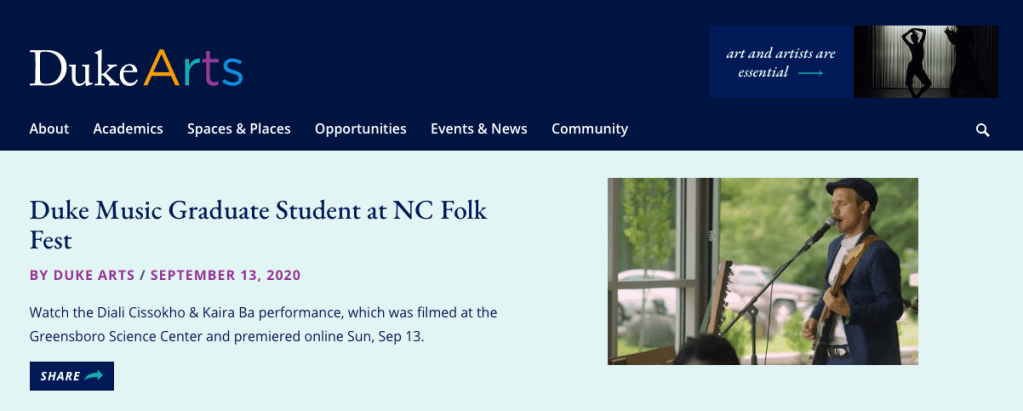
Duke Music Graduate Student at NC Folk Fest
Duke Ethnomusicology graduate student Jonathan Henderson (second from right) and his band, Diali Cissokho & Kaira Ba, performed at this year’s virtual edition of the North Carolina Folk Festival on Sunday, September 13. The three-day festival is available to stream for free.
Kaira Ba formed in North Carolina in 2011, shortly after kora master Diali Cissokho immigrated to the U.S. Kaira Ba has produced three full length albums, toured extensively in the US, and traveled twice as a band to Senegal. In 2014, Kaira Ba was nominated for the prestigious continent-wide All Africa Music Award (AFRIMA) in the category “Best African Group” for their album The Great Peace. In 2018 the band released its most ambitious album to date, Routes, which was recorded alongside a broad cast of guests in both North Carolina and Senegal.
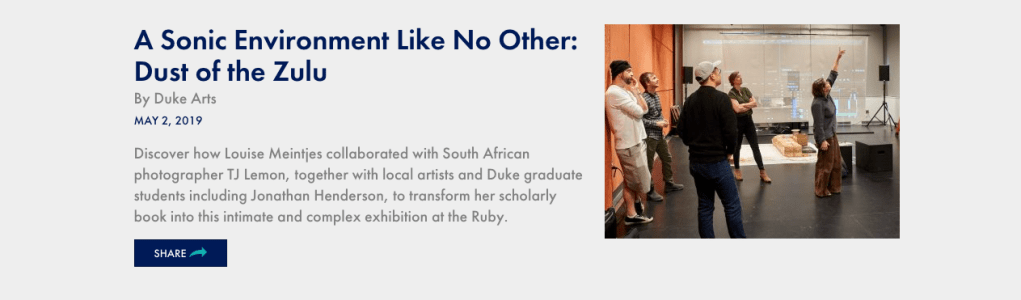
A Sonic Environment Like No Other: Dust of the Zulu
In March and April 2019, Louise Meintjes and TJ Lemon’s Dust of the Zulu exhibition transformed the Ruby’s Murthy Agora into an immersive environment filled with resonating voices, glowing portraits, and vivid ethnographic video.
The Dust of the Zulu installation interpreted twenty-five years of research on ngoma, a social song and dance form performed by migrant Zulu men in South Africa. We met with author and ethnomusicologist Louise Meintjes and one of her collaborators, Jonathan Henderson, to discuss their work on this intimate and complex exhibit.
Henderson worked with fellow ethnomusicology graduate student Cade Bourne on the music production and sound design, while Duke MFA EDA student Jonghwan Choi and visual journalist Bridgette Cyr assisted in producing the stills and video. TJ Lemon, a photo journalist based in South Africa, took many of the photos in Meintjes’s book and presented a selection of his most powerful work in this installation.
 Jonathan Henderson